
Note: This article is an opinion piece and reflects the personal views of the author.
Gukesh’s historic path to the world title
Gukesh’s chess speaks for itself! He is the only teenager to win the FIDE world championship apart from Ukrainian Ruslan Ponomariov. Whereas Ponomariov obtained his title when FIDE experimented with a knockout format that morphed into the present-day World Cup, Gukesh went through the traditional process of qualifying for the Candidates, winning the Candidates and then defeating the title holder in a match. In fact, only one other player accomplished this feat at their very first attempt, Mikhail Tal back in 1960! That shows how exceptional Gukesh is, and it’s easy to forget that he’s only 19 until May and still leads the FIDE junior list by nearly 100 Elo rating points.

It’s interesting to historically compare Gukesh at 19 against some of his great predecessors who are popularly nominated as chess GOATs. I have used the birth year instead of the absolute date of birth for simplicity, described their career and future progression, and annotated two defeats that give us an idea of their strength at 19.
1911: Alexander Alekhine at 19

Born into a wealthy aristocratic family, Alekhine’s chess career began with correspondence games and tournaments in Russia. His early games already bear his unmistakable style: a relentless pursuit of the initiative coupled with a sharp eye for tactics and combinations. Alekhine made his international debut at 19 at the large 26-man Carlsbad tournament. Although Alekhine lost 9 games, he won 11 and finished in a creditable tie for 8th -11th.
Five-year trajectory:
Alekhine continued to be successful locally and won a Dutch tournament in Scheveningen in 1913. In 1914, he tied for first with Nimzowitsch in the all-Russian Masters tournament. The two drew a playoff match, and both were invited to the St. Petersburg 1914 tournament. Alekhine finished within the top five in the preliminary stage, qualifying for the five-man double round robin final section where he finished 3rd, below Lasker and Capablanca and ahead of Tarrasch and Marshall. His further development, like his contemporaries, was stunted by the outbreak of World War I, and afterwards by the Russian Revolution. It would take another decade before Alekhine, now settled in France, became a serious contender for the world championship. By coming second to Capablanca at the New York 1927 tournament, he became the challenger and defeated the Cuban to the surprise of many experts.
1955: Mikhail Tal at 19

The young Tal was a genius at everything and even entered university at 16. In junior chess circles, people talked about a crazy Latvian boy who happily sacrificed pieces unsoundly, but this would only be discovered by careful analysis after he had won! But surely you could not play in this way against adults? At 19, Tal would play for the first time in the qualification process for the national championship. In the quarterfinals, he finished 3rd and then won the semifinals ahead of well-established masters!
Five-year trajectory:
Tal shared 5th-7th at his first appearance at the USSR championship in 1956. So, he could play against adults too, but surely his play was too risky to beat the very best. He would prove them wrong by winning the next two USSR championships! Tal won the Interzonal tournament in 1958 and then the 1959 Candidates tournament by a 1.5 point margin. He would now face the final challenge: a title match against Mikhail Botvinnik, the patriarch of Soviet chess. Tal won by a 4-point margin – the most one-sided of Botvinnik’s title defences - and proved a psychological style of chess can be as successful as correct play: ‘I know I made what appeared to be a bad move at times, but they served the purpose of making my opponent use up time while I made such moves.’ A truly unmatched trajectory – from being awarded the Soviet master title in 1955 to world champion in 1960. Unfortunately, health problems that became progressively more serious hampered Tal and his reign at the top lasted only a year, losing the return match against Botvinnik by an even more one-sided 13-8.
1962: Bobby Fischer at 19
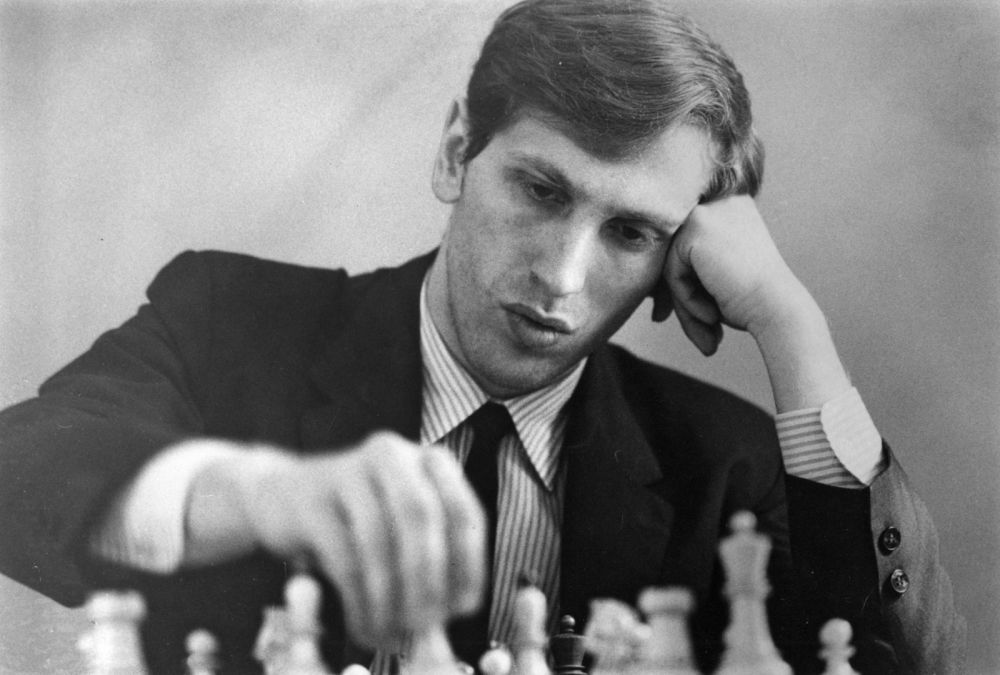
Fischer received the grandmaster title by qualifying for the Candidates when he was only 15. By the time he was 19, Fischer (unlike his predecessors Alekhine or Tal) was already established among the world's top players. At the beginning of the year, he would dominate the Stockholm Interzonal, winning by a margin of 2.5 points. Not only was he the first non-Soviet to win an Interzonal, but he was undefeated against their contingent, beating Korchnoi and drawing with Petrosian, Geller and Stein. Sadly, this seemed to make him overconfident and play superficially for the rest of the year. He finished in 4th place at the Candidates tournament with a modest +1 and lost three games on board 1 at the Olympiad. Altogether, Fischer suffered 11 defeats in 1962, of which 8 were uncharacteristically with White.
Five-year trajectory:
A disappointed Fischer went into semi-retirement, accusing the Soviets of collusion and arranging short draws between themselves at the Candidates to conserve energy when playing the rest. He refused to take part in the next cycle, but his protests were addressed by FIDE, which changed the Candidates from a tournament to a match format. Eventually, Fischer returned to top-level chess, finishing second to Smyslov at Havana 1965 and second to Spassky at the 2nd Piatigorsky Cup in Santa Monica 1966. He would lead the Interzonal in 1967 before quitting twice over disputes around his playing schedule. Just when it looked like his undeniable talent would never attain the summit, in 1970 Fischer would complete and win the Interzonal by a margin of 3.5 points. In 1971, he crushed his fellow Candidates: Taimanov 6-0, Larsen 6-0 and Petrosian 6.5-2.5. Until the last minute, it was unclear if he would show up for the ‘Match of the Century’ against Spassky. He did, and despite defaulting the second game, won by 12.5-8.5 and went on to boast that he aimed to emulate Lasker’s 30-year reign as world champion. In fact, he did not play a single game and forfeited the title in 1975 over disagreement with FIDE over the match rules.
1970: Anatoly Karpov at 19

Anatoly Karpov gained the international master title at 18 by winning the world junior championship, and his trainer, Semyon Furman, expected the university student to become a grandmaster in a year or two. Karpov began the year by winning the Russian championship undefeated. He surprisingly reached the norm at his first attempt in Caracas, finishing 4th-6th in a field of 16, to become the world’s youngest grandmaster. The year ended with the USSR championship debut, where another strong performance resulted in a tie for 5th-7th. Adult Karpov had arrived and was clearly improving rapidly. For each player, I selected one game as White and one as Black, but for Karpov this was impossible – in 1970, he only lost four, all with Black!
Five-year trajectory: Karpov’s steep ascent is reminiscent of Tal and he was nicknamed ‘Anatoly Grozny (the fearsome)’. He shared first with Stein at Moscow 1971 (ahead of stars such as the world champion Spassky, ex-champions Smyslov, Tal, Petrosian and candidates Bronstein, Korchnoi, among others), shared first with Korchnoi at Hastings 1971/72 and shared first with Petrosian at San Antonio 1972. In the world championship cycle, he shared first with Korchnoi at the 1973 Leningrad Interzonal. The 1974 Candidates matches featured a gauntlet of more experienced Soviets, but Karpov defeated Polugaevsky, Spassky and Korchnoi in succession to earn a title match against the reclusive Fischer. If they had played, I suspect the match would have been finely balanced, but Fischer defaulted. From international master to world champion in five years!
1982: Garry Kasparov at 19

Kasparov had a breathtaking rise as a teenager. In 1978 (aged 15), he became the youngest to qualify for the USSR Championship, where he finished in 9th place. A year later, in his first adult international tournament at Banja Luka, he was unrated and won the tournament undefeated by a two-point margin and then tied for 3rd in the USSR Championship. This resulted in his first FIDE rating in 1980 – from zero, he climbed to 2595 without a title! By the January 1982 list, he had risen to 2640, 4th below Karpov, Timman and Korchnoi and by July to 2675, second only to Karpov at 2700. Kasparov was the spiritual descendant of Alekhine, with equally deep and creative opening preparation and a flair for dynamic and complex play. At 19, Kasparov focused his energy on becoming the next world championship challenger. He won the tournament in Bugojno (ahead of Polugaevsky and Ljubojevic) and the critical Moscow Interzonal (1.5 points ahead of Beliavsky). Later, another strong performance on board 2 (8.5/11) at the Chess Olympiad, including a memorable win over Korchnoi on board 1 after Karpov sat out the match, led chess journalists to present him the ‘Oscar’ as the player of the year. Incredibly, Kasparov was undefeated at all these events! He lost only two games in a Soviet team event that year, making my choice easy.
Five-year trajectory:
Like Karpov, Kasparov faced only Soviets (except in the case of the defector Korchnoi) in his Candidates matches: Beliavsky, Korchnoi and Smyslov. He won all three matches convincingly with an overall score of +12=19-2, and the whole world looked forward to the championship clash with Karpov. The title would go to the first to win six games, but Karpov raced to a 4-0 start by 9 games. However, the flaw in these match conditions was exposed as it requires both players to be belligerent! Kasparov decided to recuperate with a series of short draws, which Karpov did not mind, preserving his lead. After dragging on for five months and 48 games, the scoreline was 5-3 when FIDE president Florencio Campomanes declared the match abandoned. The rematch a year later was closely fought but ultimately won by Kasparov, who would successfully defend his title three more times against Karpov. Truly an epic rivalry over the chessboard, despite Karpov’s 12-year age handicap.
2009: Magnus Carlsen at 19

Magnus Carlsen’s ascent can be charted by his progress at the annual Wijk aan Zee tournament: In 2004 (age 13), he won the C group with 10.5/13 and by April makes his third norm to become the world’s youngest grandmaster (just like Fischer and Karpov in their time). In 2006, he shared first in the B section with 9/13. In 2007, a temporary setback, finishing last in the A group with 4.5/13, followed by a triumphant return in 2008 to share first with 8/13. As we enter 2009, he is rated 2776 and ranked 4th below Topalov, Anand and Ivanchuk. Corus ends in a tie for fifth with 7/13 but the rest of the year was very good, perhaps aided by training sessions with Kasparov: third at Linares (where he defeated world champion Anand for the first time in classical chess), shared second at Sofia, shared second at Dortmund, first with an amazing 8/10 and TPR of 3002 at the double round-robin Nanjing, shared second at the Tal Memorial and first at London. This string of results raised Carlsen’s rating to 2810, topping the January 2010 list.
Five-year trajectory:
Carlsen declined to play in the Candidates claiming dissatisfaction with the long cycle times, player selection criteria and match format and stated the #1 ranking was more important to him than the title. Indeed, Carlsen has maintained his prime position in the rating list unchallenged since July 2011! Ultimately, FIDE switched back to a Candidates tournament from the match format that Fischer preferred. Carlsen won the 2013 Candidates in a dramatic tiebreak over Kramnik and then defeated Anand to become world champion. After successfully defending the title against Anand, Karjakin, Caruana and Nepomniachtchi, he again expressed disapproval over the format and has since not participated in the classical world championship.
2025: Dommaraju Gukesh at 19

In the land of myriad chess players, Gukesh’s ascent is phenomenal. A grandmaster before the age of 13, and still the third youngest ever. Towards the end of 2023, he overtook Anand as the highest-rated Indian. The year 2024 was literally golden, as he won individual and team gold Olympiad medals. This was only the icing on the cake, as more noteworthy was winning the Candidates and then the world championship by defeating Ding Liren in a closely contested match. Every other great at 19 aspired to be a world champion, but Gukesh reached this goal at 18!
The newly crowned champion tied for first with Praggnanandhaa at Tata Steel with 8.5/13 although he lost the tie break. Less satisfactory was the Grand Chess Tour, as he finished with -1 at both the Superbet Chess Classic Romania and the Sinquefield Cup. At Norway Chess, he scored 50% in the classical games and finished 3rd, while at the European Club, an undefeated 4/5 won the individual gold medal on board 1. Gukesh elected to play in two events where the prize of qualifying for the Candidates was superfluous – the FIDE Grand Swiss and the FIDE World Cup. Both ended in disappointment, as he lost three games in a row at the Swiss and was eliminated in the third round at the World Cup.
Five-year trajectory:
Last year undoubtedly brought mixed results for Gukesh. Time will tell what the next five years holds but history shows that all the other world champions continued to evolve and improve in their 20s and we can expect the same of Gukesh.
How to beat a chess great
The illustrative games should convince you that every world champion is human and can be beaten. There are some common themes among these defeats that you can apply in your own games:
1. Take over the initiative
Alekhine and Kasparov, masters of dynamic play, floundered in the passive endgames Burn-Alekhine and Romanishin-Kasparov that could be held by patient defence. In Benko-Fischer and Dementiev-Karpov, the future world champions strayed from their usual openings and landed in unfamiliar middlegames. Their opponents maintained a chokehold, avoided any counterplay, and won with ease. In such situations, your opponent simply cannot reveal their class.
2. Attack the king
King safety is the most important factor in chess and that holds true at any level. Many of these games were decided by direct attacks on the king: Alekhine-Johner, Lutikov-Tal, Ivkov-Karpov, Carlsen-Wang Yue, Kramnik-Carlsen and Gukesh-Erigaisi. The attacking side did not always play precisely, but a mistake is much more fatal for the defender.
3. Do not be afraid
Great players are united by their will to win but sometimes they get carried away, especially against lesser opponents. Watch out for overoptimism, as in Tal-Korchnoi, Fischer-Donner and Kasparov-Gulko. These games featured sacrifices that were refuted by careful play.
4. Strengths can be weaknesses
The strengths of these chess greats are often their weaknesses as well. Carlsen’s unwillingness to draw without expending every resource led him to underestimate the attack against Wang Yue and Kramnik. Gukesh thrives in calculation-intensive positions, but it is challenging to foresee every nuance in every game. Tal enjoyed attacking but folded against Lutikov when he was on the receiving end. Fischer liked clarity and was less at home with the intuitive sacrifice against Donner.
How strong is Gukesh at 19?
Having completed this survey, I ranked the players according to experience and strength.
Experience | Strength |
|---|---|
Gukesh | Kasparov |
Fischer | Carlsen |
Carlsen | Fischer |
Kasparov | Gukesh |
Karpov | Karpov |
Alekhine | Tal |
Tal | Alekhine |
Experience
At 19, Gukesh was already a seasoned grandmaster for six years. Although I focused exclusively on classical chess, he has benefited tremendously from the profusion of other formats such as rapid and blitz and online chess that did not exist even for Carlsen, and these have added to his experience. I have placed Fischer and Carlsen next and given priority to Fischer who played in the Candidates twice (and those were quadruple round-robins, double the current length). Kasparov had two years of experience of playing in strong international tournaments while Karpov, Alekhine and Tal mainly played in national events.
Strength
At 19, Kasparov stands head and shoulders above the rest as undisputed #2 and he would become world champion within three years. Carlsen was sandwiched between a triumvirate of world champions – Anand, Kramnik, Topalov – and it would be a few years before his absolute domination. Both Fischer and Gukesh were among the top ten at 19, whereas the rest were at an earlier stage of their career.
Overall, we can conclude that every chess great was imperfect at 19. Gukesh may not be the strongest at this age, but he certainly ranks among the top. Chess has made tremendous strides over the last century, and the richness and complexity of Gukesh’s games, even his defeats, is in a different league compared to his great predecessors, and we can look forward to even better play in his twenties.
About the author

A. Ganesan is a Malaysian of Tamil descent and a university professor of chemistry in the United Kingdom. Chess is one of his hobbies. He plays in the local chess league and has an English Chess Federation rating of around 2100. He also plays online on FIDE Arena, where he holds the International Master (IM) title.


