

The Man Who Keeps the Peace: Vasant BH on Two Decades of Arbitering
International Arbiter Vasant BH is a familiar face at Indian chess tournaments from the Delhi Open to major international events, including a stint officiating at the World Cup in Goa in 2025. But his journey into arbitering wasn't planned. It began, quite simply, because of his son. In this candid conversation, Vasant BH looks back at nearly two decades on the tournament floor, the disputes, the dilemmas, the emotional moments, and the lessons he's picked up along the way.
Behind the Scenes with Vasant BH
From an accidental start on the tournament floor to officiating at the highest levels, International Arbiter Vasant BH has spent two decades at the heart of Indian chess. In this candid conversation, the veteran arbiter reflects on the complex, often unseen world of rule-keeping, the emotional intelligence required to handle high-stakes disputes, and the profound community bond that keeps him coming back to the board year after year.

Devansh Singh: How did this journey begin? I understand it started because of your son.
IA Vasanth B H: It is true. I was a player from a very remote area, a place where, in my childhood, we never even had electricity. We used to play there, and since I studied in a hostel, I had a lot of indoor time to play. That's how I started.
After completing my studies, I joined the National Aerospace Laboratory, a research organization, and I was fully occupied with work. So chess stopped for me. Then, when my son was born, I naturally needed to keep him busy, so we started playing together — and suddenly he started defeating me. That's when I thought it was time to put him into proper training, and I began taking him to tournaments. This was around 2004 to 2006.
Q. What was the incident that really pulled you into arbitering?
A. It was very interesting. In those days, we didn't have many FIDE-rated players. Organizers used to assign local ratings to their own players and do manual pairings. So if organizer A ran a tournament, his students would win. Then at the next tournament, run by organizer B, the same two students would somehow win again even though other players who had played in the first event were also present. It created a lot of confusion.
So I thought that there must be rules to follow. I searched online, because I didn't know much about ratings at the time, and found some material on it. I told the organizers there were rules that needed to be followed. One of them said, rather sharply, "When you become an arbiter yourself, you'll understand the problem, talking from outside is easy." As a kind of dare, they gave me the Under-7 section to run directly.
It became a matter of prestige for me at that point. I told them that once the event was inaugurated, parents, and even the organizer weren't allowed inside. I asked for one assistant, a lady who was a parent of one of the boys, since I couldn't take a female child to the washroom myself; that wouldn't have been appropriate even as a parent. They agreed, relieved to hand over that responsibility.
I went in with a lot of chocolates, that was my preparation! Once I built some trust with the kids and they started talking to me, things became much easier. I made sure both children were escorted out properly to their parents, and everyone was happy. The organizers said the arbitering was good, and gave me the Under-9 section next. That's how the journey started.

Rest day at 2025 FIDE World Cup held in Goa, India.| Photo: Michal Walusza
Q. You're clearly very fit. We played on the same football team during the rest day at the Goa World Cup in 2025. What's your secret, given that arbitering often means sitting at a laptop?
A. Nothing special. I just walk a lot and I don't like to sit in one place. But your question is important. These days, 99% of the time, we need to be present in the hall itself. Even for a touch-move claim, the player will insist, "call the chief arbiter." So if it's a big hall, just moving around to attend to these claims is enough walking in itself.
Q. What was the trickiest touch-move type situation you've had to handle?
A. At a previous kids' international event, a player called for the chief arbiter over a touch-piece issue, but told my section arbiter, "I know the rules, I want only the chief arbiter, not you." That was actually a mistake on the player's part.
By the time I reached him, my subordinate had told me he'd been going on about many things, but the moment I arrived, he'd gone quiet. I asked him directly which article he was claiming under. He didn't know, so I told him that it's Article 4: if you touch a piece during your move, you must move it, provided a legal move exists. He agreed once it was explained clearly.
The lesson for me was that we need to talk in the players' own language. With children, we speak gently, with a smile. Generally they tell the truth. Though sometimes, yes, they come prepared with a different story. You adjust your approach accordingly, and it usually becomes easy to resolve.
Q. As a former player yourself, do emotions ever creep in when you're arbitering and an Indian player is competing in a big event, like the World Cup?
A. Naturally, it happens. But as arbiters, we have to control ourselves. We know our limit; we cannot show our emotions, not even in advance. Sometimes just through a handshake a player can sense your inclination, so we try to keep everything neutral. Internally, of course, we think, "oh, that's a good move" but outwardly, we control ourselves completely.
Q. What's your favourite memory from your years as an arbiter?
A. There are many, but one stands out. It was in Delhi, around 2014-15, back when players still brought their own clocks. One player left her clock behind in the hall. That evening, I got a call from her mother saying her child had left the clock inside. I asked which board, and then asked her to send the child to collect it.
The mother said, "she can't come, she's too young." I told her that you've given her every opportunity to play; taking care of her equipment is also part of that responsibility. If we don't teach them this now, it becomes the parent's mistake. I'm a parent too, so I requested she at least accompany the child. She came, and the child apologised. I told her that many players don't even have proper shoes; you're fortunate your parents support you this way, so it's your responsibility to look after your things.
Three or four years later, there was another incident at a Delhi tournament. A grandmaster failed to arrive on time, and I gave a walkover. He turned up two minutes later, saying the organizer hadn't arranged his car. I was in a difficult spot. I'd already made the decision, so I referred it to the appeals committee. But committee members were themselves playing in the next round, and couldn't convene in time.

GM Timur Gareyev playing the third round after losing due to a walkover in round two
So I made a bold call: I allowed the player to compete, on the condition that the digital board connection be removed and both players write their moves by hand and the result would only be confirmed once the appeals committee ruled. Both agreed, and the game went ahead. He won. But afterwards, the appeals committee said it wasn't their concern since I'd already made the walkover decision, and it stood. The player took the matter to the media.
Interestingly, they sought opinions from other players on what should have been done and the very girl who'd left her clock behind years earlier was one of about four people who commented on it. That connection has stayed with me.
In another tournament, a lady found a mangalsutra — gold, likely over 200 grams lying on the ground and handed it to me, unsure who it belonged to. It was a tricky situation. At the start of the next round, I announced that an important item had been found, and asked anyone who might have lost something to check their belongings and come to me. A player eventually approached, distressed that her mangalsutra was missing. I confirmed the details and returned it to her. It could easily have been kept because 200-plus grams of gold but that's the trust within our chess family. I remember telling everyone that moments like this are exactly why we're happy to be part of this community. Over the years we've recovered mobile phones, laptops, even cash, and returning them always gives us a boost to keep going.
Q. Is arbitering financially sustainable as a full-time career, especially for someone working up from national to international arbiter?

Vasanth B H at 2nd Namma Bengaluru GM Tournament |Photo: Shahid Ahmed
A. No, it isn't sustainable. Earlier, there were very few arbiters, but now India has more than 3,000. Supply is far greater than demand. In fact, to earn norms, many arbiters offer to officiate for free. Norms require staying through the process, and while some states offer decent remuneration, most don't. So sustainability, honestly, isn't really possible right now, even with so many tournaments happening.
Q. Some arbiters clear seminars easily but struggle once they're actually on the tournament floor, hesitant to make decisions. Should the seminars be stricter?
A. You're absolutely right. But the reality is, we need a large number of arbiters — tournaments are happening in every corner of the country. If we evaluate too strictly at the entry stage, it becomes very difficult to find enough people.
What happens naturally is this: once people come in and start officiating, many realise after two or three tournaments that it isn't for them, and they leave on their own. The ones who stay are generally the better ones. So rather than filtering people out at the gate, it's better to let them experience it and decide for themselves.
Also, remember that there are only twelve articles in the rulebook, and answering questions on paper is easy. But at the board, players don't ask questions clearly; you have to infer what they actually mean, sometimes repeating the question three or four times to understand the real issue. That takes a different kind of skill, and it's what separates those who survive in this role from those who don't. Word travels fast too, if an arbiter gives a poor decision, players talk, organizers hear about it, and that arbiter simply stops getting invited. It's self-correcting in that sense.
Q. Anti-cheating measures have become far more prominent in recent years. How do you handle situations involving frisking, especially given how sensitive they can be?
A. It's a very important point. In one case, a German grandmaster complained that an Indian IM was playing suspiciously strong, computer-like moves. We couldn't act mid-game, so we said we'd observe and frisk afterwards, once the game ended, generally using a same-gender official for the search.
During that particular frisking, the person conducting it touched the player's sacred thread. He was a Brahmin and without realising its significance, the player was understandably upset. I apologised immediately, explaining it was unintentional. These situations are genuinely delicate.
In another case, a player kept his hand near his socks throughout several games, which caught our attention. After observing three or four games, we frisked him and found an earphone. He claimed it wasn't his, that someone had planted it and when asked why he'd kept a phone in his socks rather than his pocket, he said he had an allergy that prevented him from keeping anything in his pocket, and that he needed to check his ailing grandfather's pulse regularly. We didn't accept the explanation. We annulled the result of the previous game, gave him a zero, and reported it to FIDE. That led to about three or four legal notices from civil court afterwards. These things are more common than people realise.

At the International Chess Tournament organized by Chola Chess foundation.
Q. How do you decide whether to annul just one round, or more?
A. It depends on intent. If a player is found with a phone in his pocket, the general assumption is that it was forgotten, that's understandable. But keeping a phone in your socks isn't accidental; that's clearly deliberate. In cases like that, we annul the result and don't allow the player to continue in that round. Where it seems accidental, we're usually more lenient and let them play on.
Q. What's your view on the Chola Chess round-robin initiative, which is helping Indian players get norms without having to travel abroad?
A. This is a wonderful initiative, and the entire chess fraternity should be grateful to the Chola Chess Foundation and the Tamil Nadu Chess Association, who started it. In the beginning there was some scepticism because people assumed results might be arranged in favour of familiar names but that isn't the case at all. For Indian players, travelling abroad to earn norms is expensive and difficult, so this kind of opportunity at home is genuinely valuable. They've taken up an entire floor for it, with plenty of space and coaching happening alongside. It's a real boon for Indian chess.
Q. Is your son still playing chess?
A. He plays occasionally now, when he gets time off from work and he's actually the champion within his company! He follows every game closely. But he couldn't continue as a professional. After a loss at a national event in Punjab, he told me he wasn't good enough in the field and that chess would remain a hobby rather than his career, and that he needed to focus on his education instead.
Q. What would you say to a young player, say, rated 1500-1600, in their early twenties — who doesn't want to pursue chess professionally but still wants to stay connected to the game, maybe as an arbiter or trainer?
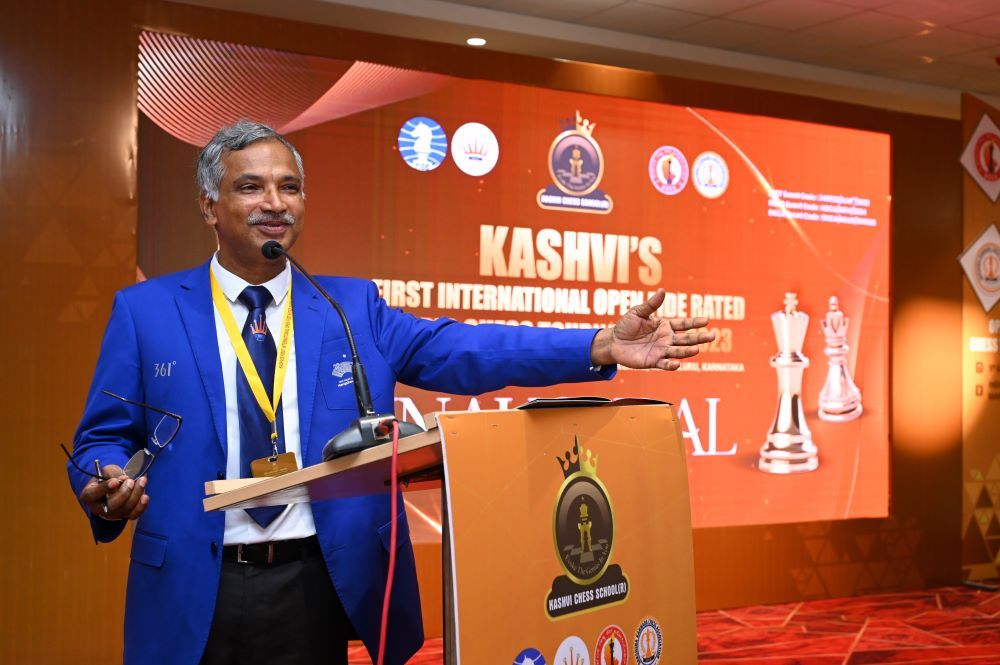
IA Vasanth B H at Kashvi’s 1st Rapid Rating Open 2023| Photo: Kashvi Chess School Kundapura
A. They should listen to their own intuition. If someone is genuinely good and meant to pursue chess seriously, that inner voice will keep pulling them back toward it. Others get inspired temporarily after reading about a big result on ChessBase and think they should become a player too but real commitment, the kind needed 24/7, comes from within.
I think of GM Girish Koushik as a good example. He became an IM, joined RV College of Engineering in Bangalore, completed his undergraduate degree, then went to Europe and earned all three GM norms with no fanfare or publicity and became a grandmaster. He's since taken up a corporate role and isn't actively playing, but he achieved what he set out to do.
Q. Can we ever expect to see you across the board again as a player?
A. [laughs] I last played over the board sometime between 1977 and 1980, during my hostel days. After that I pursued my ITI in draftsmanship and then joined the National Aerospace Laboratory, where work took over completely. I stopped playing altogether except casually with my son. I still know how to play, but not competitively anymore.
Q. You retired from the National Aerospace Laboratory in June 2023, so you're now doing this full-time?
A. Yes.
Q. After such a long career, having covered nearly every major event and seen so many players come through the system, what keeps you going?
A. It isn't the money, honestly. It's the people. After every tough tournament, I tell myself I'm done, that I won't officiate again. But within two or three days, someone calls asking for help, and I say yes immediately.
There's a young player,I won't name him, who's very fond of me but doesn't say much. He'll just wander around nearby, then come up quietly and I'll give him a hug. That's all he wants. Many children are like that, and it gives us far more joy than any financial reward. The warmth from players and parents is what pulls us back, again and again.
Q. What's next on your calendar?
A. No tournaments immediately, but I have FIDE Arbiter seminars coming up, one in September, and another in Chennai.
Q. You've watched players like Gukesh, Praggnanandhaa, and Vaishali grow up from the age-group circuit into world-class competitors. What's that been like?
A. Really special. I remember Gukesh in Thailand. He'd usually be winning through the seventh or eighth round, then somehow miss the podium at the last moment. We used to say there was something bigger waiting for him, which is why he kept just missing out. Years later, when he became World Champion, we met again in Delhi, and his father recalled that exact conversation.
I also travelled with Praggnanandhaa and Vaishali to Durban, South Africa, for a tournament. I believe it was 2012 when they were very young, along with their mother. They still call me "uncle" whenever we meet. And of course, Gukesh earned his final GM norm at the Delhi Open.
Q. Anything you'd like to say to the ChessBase audience before we wrap up?
A. Just this that chess in India has reached the people it has largely because of ChessBase. I remember a year when Sagar and his wife were away, fully occupied covering events, and people genuinely didn't know what was happening in Indian chess during that time. Today, it's hard to imagine Indian chess without ChessBase. The credit truly belongs to them.